

The Horseracing Integrity and Safety Authority has confirmed that the current federal Lasix framework will remain in place across covered US Thoroughbred racing, meaning furosemide will continue to be permitted within 48 hours of a race for most runners, while 2-year-olds and stakes horses remain excluded.
Key Facts or Race Details Summary
- HISA announced on May 5, 2026 that its board had voted unanimously on April 24
- Lasix remains permitted within 48 hours of a race for covered horses, except for 2-year-olds and stakes runners
- HISA said the Furosemide Advisory Committee found available scientific evidence did not support the claim that Lasix is performance-enhancing
- The modification takes effect on May 23, 2026
- The decision does not change the practical rule position already in place since May 23, 2023
Unanimous Board Vote Leaves Status Quo in Place
HISA announced that its Board of Directors voted unanimously on April 24 to keep the present Lasix position in force.
The decision was made under the Horseracing Integrity and Safety Act framework, which required the board to decide whether the existing prohibition should be modified after a three-year moratorium and a review of commissioned scientific studies.
Under the ruling, Lasix remains permitted for covered horses in the 48 hours before a race, except for 2-year-olds and horses running in stakes company.
HISA said the board unanimously adopted the findings required for that modification, including that furosemide is not supported by the available science as a performance-enhancing substance and that public confidence in racing would not be adversely affected.
What HISA Said About The Evidence
According to the official HISA release, the board considered the findings and recommendations of the Furosemide Advisory Committee before making its decision.
HISA said the committee found that the available scientific evidence did not support the assertion that furosemide is a performance-enhancing substance.
The regulator also said the modification will take effect on May 23, 2026, but does not alter the practical rule position already in place since the launch of HISA’s Anti-Doping and Medication Control Program on May 23, 2023.
Horsemen had pushed back against a full ban
On Wednesday, Thoroughbred Daily News reported that the prospect of a full ban had created concern among horsemen in the build-up to the decision.
The outlet said a February letter signed by leading trainers including Bill Mott, Chad Brown, Mark Casse, Jena Antonucci and Ron Moquett, along with National Horsemen’s Benevolent and Protective Association chief executive Eric Hamelback, questioned the need for a total prohibition.
“In reaching its decision, the Board considered the findings and recommendations of the Furosemide Advisory Committee (FAC), which included a finding that available scientific evidence does not support the assertion that furosemide is a performance-enhancing substance,” HISA said in a press release.
The Paulick Report, carrying HISA’s statement in full, also published reaction from National HBPA president Dr Doug Daniels, who said horsemen were encouraged that the authority had acknowledged both the science and the practical realities of equine care.
Why These Lasix Rules Matters
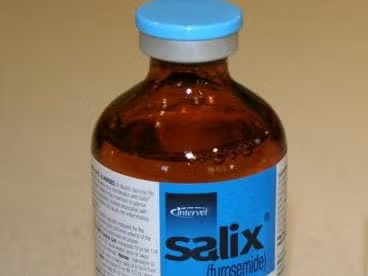
This is a significant regulatory call for US racing because the board’s decision avoids an immediate expansion of the Lasix ban to all races.
It keeps one of the sport’s longest-running medication debates in its current form while preserving the existing restrictions for 2-year-olds and stakes runners.
“The question before the Authority Board is not whether the sport must evolve–it must, it is and will continue to,” the letter read. “The question is whether eliminating a treatment that reduces lung bleeding serves the horse or simply satisfies a narrative. Treating pulmonary hemorrhage under veterinary supervision is not doping. It is responsible care.”




Comments.
Loading comments…