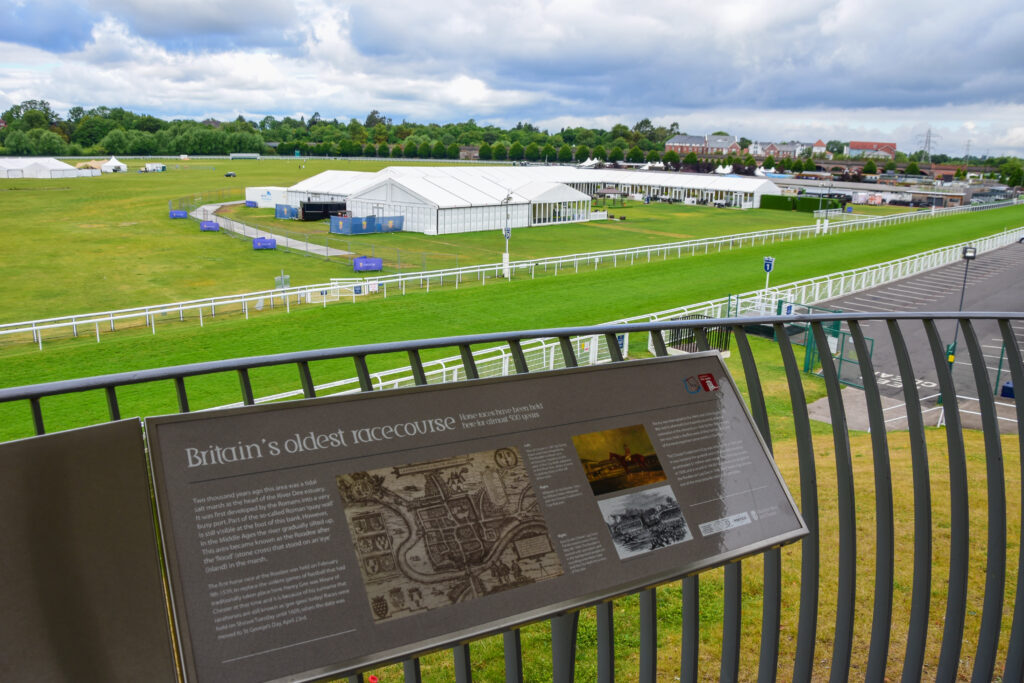

Affectionately known as The Roodee, Chester Racecourse holds the prestigious title of the oldest horse racing track still in operation in Great Britain-and indeed the world, as recognized by Guinness World Records.
Origins and Early History Of Chester Racecourse
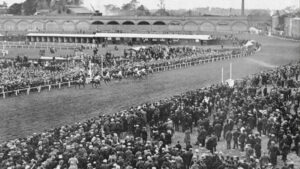
The Chester Racecourse site itself is steeped in ancient history.
During the Roman occupation of Britain, the area was a harbour on the River Dee, serving the fortress of Deva Victrix.
However, by the Middle Ages, the river had silted up, creating a grassy meadow.
The name “Roodee” comes from a corruption of “Rood Eye” – meaning “The Island of the Cross”, referring to a stone cross that still stands in the centre of the course today.
The Birth of Organized Horse Racing At Chester and Where The Term ‘Gee-Gee’ Came From
Formal horse racing began at Chester in 1539, under the authorization of Mayor Henry Gee.
Interestingly, Mayor Gee’s influence on the sport was so profound that his last name is believed to be the origin of the term “gee-gee” for horses.
Before racing took over, the site was used for the infamous “Goteddsday” (Shrove Tuesday) football matches-events so violent that they were eventually banned and replaced by the more “civilized” sport of horse racing.
The first recorded prize was a set of silver bells awarded to the winning horse.
Evolution of the Chester Track
While racing has occurred here for nearly 500 years, the infrastructure evolved slowly:
- 1766: The first “May Festival” was introduced
- 1817:The first grandstand was constructed to accommodate the growing crowds
- 1824:The Tradesmen’s Cup (the precursor to the famous Chester Cup) was established
Today, the track is famous for being incredibly “sharp” and circular.
At just over 1 mile and 1 furlong in length, it is one of the smallest major tracks in the country, requiring horses to be constantly on the turn.
Which places a massive premium on a low starting draw – especially over the sprint trip from 5 furlongs to 7 furlongs.
Backed up with 9 of the last 10 winners of the Lily Agnes Stakes (5f) hailing from gates 5 or lower.
Top 5 Oldest British Racecourses
- Chester 1539 – The undisputed “Grandfather” of racing, set within the Roman walls of Chester
- Salisbury 1584 – Racing has taken place at Netherhampton since the 16th century, frequented by various monarchs
- Lanark 1600s* – While it closed in 1977, it was historically home to the “Silver Bell” race since medieval times
- Doncaster 1614 – Home to the St Leger, the world’s oldest classic race, with records dating back to the early 17th century
- Newmarket 1622 – Known as the “Home of Horseracing,” it gained royal prominence under King Charles II
Chester Racecourse (1539): As detailed above, Chester remains the oldest active course. Its unique bowl-like setting allows spectators on the city walls to watch the races for free, a tradition that dates back centuries.
Salisbury (1584): Salisbury is often cited as having one of the earliest recorded instances of organized racing.
It has hosted many legendary horses over the centuries, including the great Eclipse, who remained undefeated throughout his career in the 18th century.
Doncaster (1614): Doncaster is famous for the St Leger Stakes, established in 1776. But the track itself was hosting races long before that.
The local corporation recognized the sport in 1614 to prevent the “disorders” of unregulated racing on the town’s commons.
Newmarket (1622): Newmarket’s status was cemented by King James I, but it was King Charles II who truly made it the headquarters of the sport.
He is the only reigning monarch to have ridden a winner there (the Town Plate in 1671). Newmarket remains the global center for breeding and training.
Ripon (1664): Known as the “Garden Racecourse”, Ripon has a history of racing on various sites dating back to the mid-17th century.
It famously hosted the first-ever race for female riders (The Lady’s Plate) in 1723.
2026 Boodles May Festival: Key Races & Significance
The 2026 Boodles May Festival (May 6th-May 8th) is a crucial stop on the road to the Classics at Epsom.
Because Chester’s tight, turning track tests a horse’s balance and agility. It is considered the ultimate trial for the idiosyncratic Epsom Downs.
Main Chester May Festival Races
- The Cheshire Oaks (Wednesday, May 6th: A “Listed” race for three-year-old fillies
- The Chester Vase (Wednesday, May 6th): A Group 3 race for three-year-old colts and geldings
- The Dee Stakes (Thursday, May 7th): A Listed race often used as a secondary Derby trial
- The Ormonde Stakes (Thursday, May 7th): A prestigious Group 3 for older horses
- The Chester Cup (Friday, May 8th): The historic, gruelling handicap over 2 miles and 2 furlongs
Significance to the Epsom Derby & Oaks
The May Festival is often the “litmus test” for potential Classic champions.
The Chester Vase & Dee Stakes → Epsom Derby
Because the Chester track is so tight, a horse that can handle the “Roodee” is physically equipped to handle the “Camber” and sharp turns of Epsom.
Iconic winners like Shergar used the Chester Vase as a springboard to Derby glory.
With Lambourn also winning the 2025 Chester Vase before taking the Epsom Derby the following month.
The Cheshire Oaks → Epsom Oaks
This race is the primary trial for fillies.
Just last season (2025), Minnie Hauk won the Cheshire Oaks before going on to sweep the Epsom, Irish, and Yorkshire Oaks.
Chester Racecourse – Key Features:
- Direction: Left-handed (counter-clockwise)
- Circumference: Approx. 1 mile, 1 furlong (the smallest in England)
- The “Run-in”: Only 239 yards-the shortest in the country, making it very hard to overtake late in the race
- The Draw: Being drawn in Stall 1 (the inside rail) is a massive statistical advantage
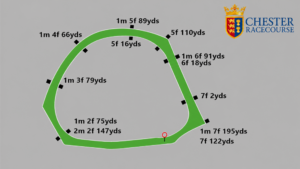
Chester Racecourse Track Map


Comments.
Loading comments…